



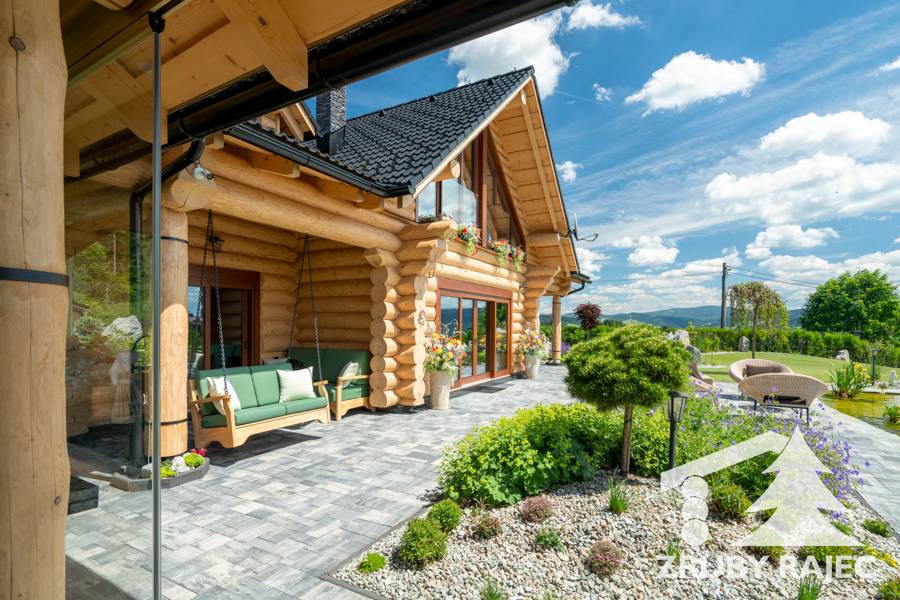
 Choosing a log house supplier is not a decision that should be made hastily. It's not just another building – it's a home that should serve many generations, be healthy, safe, and beautiful. Unlike conventional brick buildings, which can be built by a skilled craftsman with a good team, there is much less room for error with log houses – and the consequences are much more serious.
At Zruby Rajec, we believe that this is precisely why this process deserves time, attention, and careful consideration of several factors.
Wood is a living material, and each log house is unique, handcrafted by experienced craftsmen. That is why it is not worth skimping on quality in such constructions. In practice, we often encounter a number of mistakes – from poor design, incomplete and misleading price quotes, to technical shortcomings in construction. These include, for example, poor fitting of logs, inaccurate or improperly made grooves, the use of wood from calamity logging, poorly chosen diameters, or insufficient contact surfaces between beams.
The consequences can be heat loss, increased heating costs, cracking of the structure, or the need for costly repairs – often shortly after moving in.
That is why we have decided to prepare a comprehensive series of articles to help you navigate all the key questions you need to ask yourself before choosing a log house supplier.
Why are a company's history and experience crucial?
In the field of log construction, it is common for some companies to focus only on the production of the shell, with the future of the building no longer being their main concern. Other companies, on the other hand, do not have enough experience with wooden houses and therefore overlook technical details that are crucial to the quality of the result. These are often companies without a long history, with simple or outdated technological processes, or without proven references.
This is not a rare phenomenon – several younger companies on the market today present the years their founders spent as our employees as their history. It is paradoxical that these companies now offer guarantees that are longer than their actual presence on the market. We are glad to have helped train high-quality professionals, but we believe that the difference between individual experience and the know-how of a stable company with many years of experience is crucial for the customer – especially when it comes to an investment that will serve the whole family for generations.
We are the oldest company producing log houses in Slovakia and a family business with more than thirty years of tradition. Our journey began in 1992 in Šuja, where we laid the foundations of a craft that we have continuously perfected. Today, we have hundreds of projects under our belt throughout Slovakia and abroad – from the Tatra Mountains to the Alps to southern Spain.
When building with wood, you need a solid partner
We have weathered several global and internal upheavals – from the economic crisis in 2008, through the pandemic, to internal personnel disputes and the emergence of competing companies that drew on our know-how. Despite everything, we have always stood by our clients and fulfilled our commitments.
The stability and responsibility we offer is the difference between a partner and an ordinary supplier.
That is why we believe that when choosing a supplier, it is essential to ask the right questions. We have prepared a series of articles in the form of specific questions that every customer should ask themselves before deciding to work with a supplier. They will help you navigate the key stages of construction and learn what to look for when choosing a construction company and its procedures.
Every future log home owner should know these questions:
- Where does the company source its wood and how does it select it? The quality of your log home begins with the professional selection of raw materials.
- Was your project designed by a log house expert? An experienced architectural studio is a prerequisite for success.
- Does the price quote include everything it should? Don't fall for incomplete or misleading budgets.
- Can you rely on the foundations that the contractor will build? Incorrect foundations can jeopardize the entire construction process.
- How is the shell manufactured? Check that there is no improvisation. A high-quality log shell is the foundation for everything else.
- Are the finishing works adapted to log construction? Well-thought-out finishing works prevent technical problems.
- Will the company remain with you after the handover of the building? After-sales service distinguishes a partner from an ordinary contractor.
